Showing posts with label Nicholas Freeman. Show all posts

Tuesday, October 4, 2022

"Buddy! The Buddy Holly Story" at History Theatre

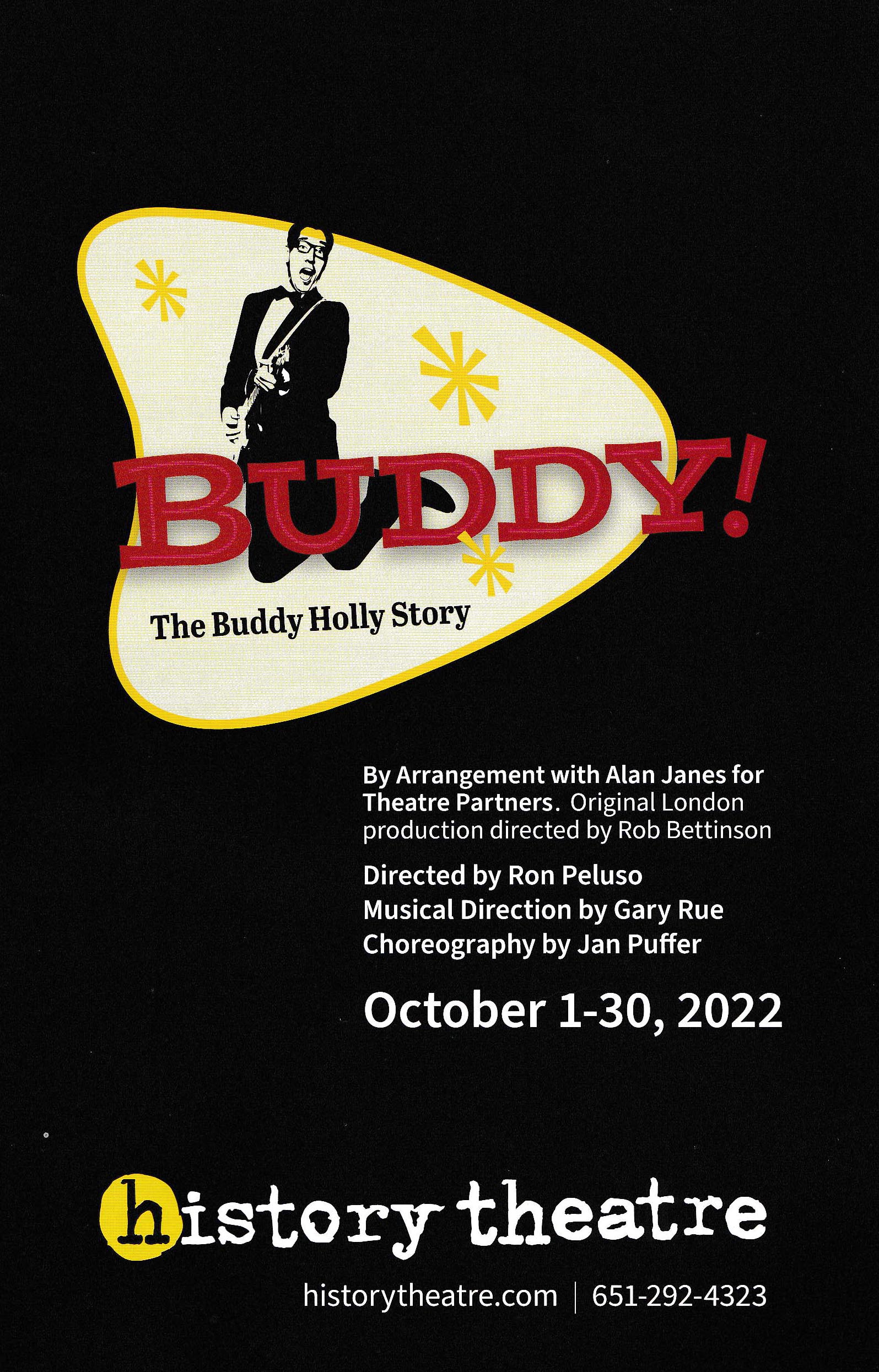
"That'll Be the Day." "Peggy Sue." "Oh, Boy." "Maybe Baby." These iconic songs by '50s rocker Buddy Holly are so much a part of our culture that everyone knows them, even those of us born long after his tragic death in a plane crash in 1959. Buddy! The Buddy Holly Story, a jukebox musical that uses Buddy Holly's music to tell his story, premiered in London in 1989 before crossing the pond to be seen on stages around the country. It's a fitting choice for the History Theatre, which brings varied and sometimes obscure pieces of Minnesota history to life on stage. What does Buddy Holly have to do with Minnesota? His doomed plane was on its way from Clear Lake, Iowa to Moorhead, Minnesota when it crashed, killing Buddy Holly, Ritchie Valens, and the Big Bopper. This production, which premiered at the History Theatre in 2005 and was remounted a few times, is back this year for the first time since 2015, with many returning cast members and creatives (including director Ron Peluso in his final season as Artistic Director). Buddy! is a fun celebration of the all too short life and career of this pioneering rock-and-roller, enjoyed equally by those who remember first-hand his life and death, and those who only know the legend (although the audience skews much more towards the former).* This run of Buddy! continues through the end of the month; click here for info and tickets.

Monday, November 26, 2018

"Teen Idol: The Bobby Vee Story" at History Theatre

This winter, History Theatre is bringing back their original play with music based on the life of local rock and roll legend Bobby Vee. You would be forgiven for not recognizing the name (especially if you didn't live through the '60s), but you would surely recognize some of his hits (e.g., "Devil or Angel," "Take Good Care of My Baby," "The Night Has a Thousand Eyes"). And that's why we have the History Theatre, to bring us edutainment about parts of our local history that we maybe don't know as much about as we should. Teen Idol: The Bobby Vee Story premiered in 2016, and the creators collaborated with Bobby's sons Jeff and Tommy. Bobby Vee died from complications of Alzheimer's during that first run of the show, bringing an extra poignancy to it. On second viewing, Teen Idol really feels like a Jeff and Tommy's love letter to their parents - a clean-cut Midwestern boy who for a short time was one of the biggest music stars in the world, and the woman who loved him but didn't sacrifice herself for his career. The play has been tweaked a little, with three new songs added, and by my count about two-thirds of the 24-person cast are new to the show. But it's mostly the same as last time: a play that transcends the jukebox musical to tell the story of how one star survived his rise to and fall from fame with grace and dignity intact, thanks in part to his family.

Monday, December 1, 2014

"Buddy - The Buddy Holly Story" at the History Theatre

"That'll Be the Day." "Peggy Sue." "Oh, Boy." "Maybe Baby." These iconic songs by '50s rocker Buddy Holly are so much a part of our culture that everyone knows them, even those of us born long after his tragic death in a plane crash in 1959. Buddy - The Buddy Holly Story, a jukebox musical that uses Buddy Holly's music to tell his story, premiered in London in 1989 before crossing the pond to be seen on stages around the country. It's a fitting choice for the History Theatre, which brings varied and sometimes obscure pieces of Minnesota history to life on stage. What does Buddy Holly have to do with Minnesota? His doomed plane was on its way from Clear Lake, Iowa to Moorhead, Minnesota when it crashed, killing Buddy Holly, Ritchie Valens, and the Big Bopper. This production, which premiered at the History Theatre a few years ago, is back this year with much of the original cast of actor/musicians and director Ron Peluso. It's a fun celebration of the all too short life and career of this pioneering rock-and-roller, enjoyed equally by those who remember first-hand his life and death, and those who only know the legend (although the audience skews much more towards the former).

The show follows Buddy's life from his early days in Lubbock, Texas, breaking out of the country-western genre and creating something entirely new, through a failed recording contract, his unprecedented string of hit songs, a whirlwind romance and marriage, and finally, to that fateful last concert in Clear Lake, Iowa. Along the way we hear many of his best hits, along with other songs of the era, including Ritchie Valens and the Big Bopper's biggest hits, "La Bamba" and "Chantilly Lace," respectively. Despite the fun music, there's a slight sense of foreboding as the audience knows how the story ends, even as Buddy and friends move towards it unaware of their fate. But we're not down for long, a brief moment of silence with a single spotlight illuminating a frozen Buddy in his final concert, and we're back to the party, with several songs continuing through and after the curtain call to leave the audience in a good mood.

Nicholas Freeman as Buddy, and the ensemble
Nicholas Freeman returns as Buddy, and fully embodies the rocker's spirit, voice, and trademark glasses (even if he does look a little more like Stephen Colbert than Buddy Holly). His experience with and dedication to this show are evident, as he brings this long ago legend to life and makes him seem like a real person. He's supported by a large and talented ensemble, many of whom are current or former students at the McNally Smith College of Music, with which the History Theatre shares a building. The students dancing on stage before the show and in the aisles during some of the numbers bring an authentic youthful energy to the show. Buddy's drummer and bass player are played with great musicianship and personality by Zac Spicer and Ryan Janssen. Lynnea Monique Doublette and Munyaradzi Tirivep embody the spirit of the legendary Apollo Theater in Harlem and rouse the crowd with "Shout!" The excellent ensemble includes Charles Fraser as several music industry people; Andrea San Miguel, charming as Buddy's sudden wife; Four Humors' Brant Miller as the Big Bopper et al.; Bryan Porter, making the most of several small roles; and Mariah Trimm, with a hilariously Midwestern version of The Star-Spangled Banner.

Refreshingly for a musical, the actors are not miked, but use retro style microphones for the big numbers. This also allows for a few lovely unplugged moments, including Buddy singing to his new wife. The stage is set up to look like a '50s stage, and the period costumes include poodle skirts, crinolines, and bow ties galore (sound by C. Andrew Mayer, set by Justin Hooper, and costumes by Lynn Farrington).

If you remember where you were on "the day the music died" and long to reminisce about the days before that loss of innocence, you'll want to catch this show before it closes on December 21 (or later, I hear it's going to be extended). If you only know of it from the song (or, for you other children of the '80s, the 1987 movie La Bamba about Ritchie Valens), this is a chance to learn a little bit more about the legend and imagine what it was like to be a bobby soxer. Either way - a good time was had by all.

Saturday, October 29, 2011

"Four Destinies" by Mu Performing Arts at Mixed Blood Theatre

Four Destinies is a play about the life of four adopted children in the same family - a sort of Sliding Doors alternate universe exploration of what would have happened if the parents had made different choices about adoption.  Local playwright Katie Leo has made herself a character in the play (played by Katie Bradley, who's a funny and natural host, with some more emotional moments towards the end), narrating, observing the action, and at times even interacting with the characters.  She loses control of her own creation as her characters' lives don't turn out as she expected.

The first act of the play is the same scene, celebrating the child's adoption day anniversary, enacted in four different scenarios.  The family repeats the same silly small talk, which becomes funny as by the fourth time the audience knows what's coming.  Shanan Custer as the neighbor and close family friend is particularly funny; I only wish she had more to do (she did a very funny skit at the Iveys last month).  In the four scenarios the child, whom the parents named Destiny, is adopted from Korea (Sara Ochs, aka Audrey in Little Shop), Guatemala (Nora Montanez), the US foster system (LeDawn James), and a local young woman who gives her baby to the Jones family at birth (Neil Schneider).  The four kids are at different ages (from 8 to college age) and different stages of accepting and embracing their past.  One little girl is afraid someone is going to come and take her away, despite her mother's assurances that she's "meant" to be with them, while another older Destiny takes back her heritage and her name.  The only white child is also the only male; he loves to play with dolls and wear dresses.  When his friends question the boy's behavior, the father (Nicholas Freeman) is sweetly defensive of his son, while in the other scenarios he's fairly distant, preferring to watch the football game rather than interact with his family.

In the second act, the playwright (who's also bought a DNA kit that promises to unlock her genetic history and solve all the mysteries of her life) plans to give her characters everything they wanted.  But that doesn't happen in life, or in this play either.  One Destiny travels to Korea and is unable to find her birth mother or any sense of connection.  One grows up to make movies like she always dreamed, but her family medical history catches up with her.  One has a successful career, only to end up unexpectedly pregnant and facing the same issues her birth mother faced.  The male Destiny calls his birth mother (Shanan Custer getting to flex her dramatic muscles) and finds "the story" not what he imagined.  Finally, the playwright doesn't find any answers in the DNA results.  Where does this leave us?  This is one of those open-ended plays where nothing is resolved.  But maybe that's the point.

At the beginning of the play, Katie the character jokingly claims to speak for all adoptees because they all feel and experience the same thing.  That's obviously not true; instead Katie the playwright presents four very different experiences, all in the same family.  She brings up interesting ideas about fate and what's "meant to be."  I'm not sure I believe in "meant to be;" I believe in what is.  That's really all we have to cling to.