
theatrical musings in Minnesota and beyond
Showing posts with label Kevin D. West. Show all posts
Showing posts with label Kevin D. West. Show all posts
Sunday, March 6, 2022
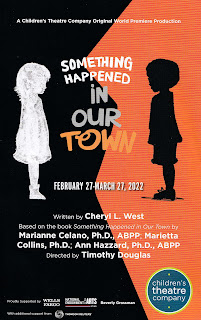
"Something Happened in Our Town" at Children's Theatre Company

Sunday, September 23, 2018
"Is God Is" at Mixed Blood Theatre

Monday, February 6, 2017
"The Highwaymen" at History Theatre and "The Whipping Man" Minnesota Jewish Theatre Company
Yesterday, when most of the world was watching some sporting event on TV, I saw two plays in St. Paul that spoke to the African American experience. When I sat down to write about one or the other today, I found that I couldn't separate the two. Maybe it's just because I saw them on the same day, but it seems like the two plays really speak to each other. History Theatre's world premiere of The Highwaymen and Minnesota Jewish Theatre Company production of The Whipping Man ("one of the most widely produced new American plays of the last several seasons") essentially tell the same story, 90 years apart, one in St. Paul, Minnesota and one in Richmond, Virginia. A story that continues to occur today in cities and small towns across the country. A story of black people being sent to the whipping man, of being sold South, of having their homes bulldozed to make way for "progress," of being imprisoned at a disproportional rate, of being denied education, of being shot by the police for walking down the wrong street. Both of these plays are really excellent productions, not always easy to watch, that shed light on one of the most important issues of our time.

| 
|
Saturday, October 15, 2016
"Jitney" at Penumbra Theatre

Saturday, February 7, 2015
"By the Way, Meet Vera Stark" at Penumbra Theatre

The first act of the play takes place in 1933, where we meet Hollywood starlet Gloria Mitchell and her former Vaudeville partner Vera, who works as her maid while trying to break into pictures (doesn't everyone who lives in Hollywood want to be in pictures?). Gloria is up for a role in The Belle of New Orleans, and Vera is desperate to be cast in it as well. Gloria is too preoccupied with her own life to help her friend, so Vera takes matters into her own hands when the studio head and director come to Gloria's apartment, playing into their stereotypes and getting cast. The second act jumps forward in time 70 years to a seminar about the legacy of Vera Stark in which the panel discusses her life and work while watching clips from the movie (pre-recorded video) and a 1973 talk show appearance (live reenactment) that reunites Gloria and Vera.
 |
| Norah Long as Gloria as Marie and Crystal Fox as Vera as Tilly, in the classic "tightening the corset" scene in The Belle of New Orleans (photo by Allen Weeks) |
The production elements on this play are as divine as the cast. Mathew LeFebvre's gorgeous costumes span the range from glamorous '30s Hollywood, to real working women in that era, to the fabulously colorful '70s, and modern day specific types. C. Lance Brockman's versatile set easily transforms from Gloria's luscious apartment to Vera's working class apartment to a studio back lot with just a change of furniture and the flipping of panels in the walls. A really fun feature of this play is that we actually get to see the movie that's talked about so much. A quite lengthy clip of The Belle of New Orleans is played on a big screen in which the four women play roles in this deliciously melodramatic movie.
By the Way, Meet Vera Stark is a really fun, entertaining, funny, beautiful to look at play on the surface, but on a deeper level says some important, thought-provoking, and relevant things about black actors in Hollywood, then and now. And it's quite timely, coming a few weeks after the announcement of this year's Oscar nominations, which included not only the snub of the film Selma, but the first all-white group of nominated actors since 1998. Hollywood, and we its audience, still have much to learn from Vera Stark (playing through March 1).
This article also appears on Broadway World Minneapolis.
Monday, December 5, 2011
"I Wish You Love" at Penumbra Theatre

I Wish You Love is a Penumbra original; written by Dominic Taylor, head of Penumbra's new play development program, and directed by Artistic Director Lou Bellamy, it premiered at Penumbra earlier this year. The play is a fictionalized account of Nat King Cole's 1957-1958 TV variety show, the first hosted by an African American. The sponsors were skittish, and Cole ended up putting his own money into the show to keep it on the air. The play branches off from that and shows us the racism behind the scenes of the show; the network and sponsors didn't want any of the black band members to appear on camera, and Nat received death threats. The network insisted he go on a national tour to prove his national popularity, ending in his birthplace of Alabama (he grew up in Chicago). This was during the height of the Civil Rights movement and the violence surrounding it. Nat and his band were caught up in the violence, which brought a whole new reality to what they were seeing on the news every night.
The scenes in the play cover rehearsals, breaks, and the TV show itself. Video images are beautifully and effectively woven into the live action on the stage. When the show goes live, a camera in the back of the theater videotapes what's going on onstage, which is simultaneously broadcast on several black and white TVs hanging over the stage. It feels like we're at a live taping of "The Nat King Cole Show," complete with "Applause" signs and vintage commercials that come on during the breaks. We also get news reports of the growing violence in the South and see real news footage projected onto the screens. It's quite a contrast between the smooth, pretty music in the TV studio and people being beaten on the streets in the news footage.
I'm not that familiar with Nat's music (other than his Christmas album and his posthumous duet with his daughter Natalie), but I've been watching some videos of him on youtube, and Dennis Spears seems to have captured his mannerisms, his voice, and his spirit. You see two Nat King Coles in I Wish You Love - the smiling public face, and the behind the scenes real man who is frustrated with the sponsors and the network. As soon as the countdown to live TV begins (five, four, three, two....), Nat puts on his million dollar smile and speaks to the camera, and to his audience watching at home. And then he sings in that familiar velvet voice (musical direction by Sanford Moore). As soon as the cameras are turned off, reality sets in and he lights up a cigarette (Nat died of lung cancer at the age of 45) as he interacts with his band or the producer. Nat's band members (inspired by his real life trio) are played by the always great Kevin D. West as the bass player and long-time friend of Nat's, and newcomer to the Twin Cities theater scene Eric Berryman as the young guitar player Nat takes under his wing. We learn more about Nat and his life and goals through the stories, jokes, and pain he shares with his friends. The show's producer, who does the best he can for Nat within the restrictions placed upon him, is played by Michael Tezla (my co-star from A Serious Man).
In what turned out to be a fascinating and completely unplanned but somehow serendipitous pairing of theater, I saw the Chanhassen's production of Hairspray the same weekend that I saw I Wish You Love. Both shows are set in a similar time period and deal with segregation. Both explore the use of TV and music to help break down the barriers between the races, but in very different ways. Hairspray is a fairly simplified version of events, in which everyone ends up happily and peacefully dancing together, and it's a white girl who leads the way. I Wish You Love is a much more realistic view (we see several violent images that are hard to look at) of the struggles of African Americans that continue to this day. There is no happy ending for Nat King Cole, just continued struggle, and progress mixed with setbacks. Both shows deal with an important and unpleasant part of our history that really wasn't all that long ago. I found that they complemented each other nicely, one a "fairy tale," and one a very real tale of one man trying to make a difference just by his very presence in American living rooms across the country through the power of television.
Tuesday, October 11, 2011
"Two Trains Running" at Penumbra Theatre

Ma Rainey is set in the 1920s, and Two Trains Running is set in the 1960s. It has a little more of a happy ending that what I remember from Ma Rainey, which has a pretty bleak outlook. This play takes place in a fading restaurant in Pittsburgh in 1969. The city wants to buy it from the owner, Memphis, and he's determined to set his own price. The play's characters are the locals who frequent the restaurant (played by many of the same actors I saw in Ma Rainey). They play the numbers in hopes of a way out, drink coffee, argue with each other, and visit "Aunt Edna," a woman who claims she's over 300 years old and can predict the future.
James Craven (who still sounds like Tommy Lee Jones) is Memphis and has a couple of great moments, including a drunken celebratory scene. Memphis' land was taken away from him in the South, so he moved north to make a better life for himself. He has, but still thinks about going home. Crystal Fox, the only woman in the cast, plays the unappreciated waitress Risa. She drags her heels slowly around the stage, pouring coffee, wiping down tables, and refilling the sugar. Her weariness with life is evident in every word, expression, and movement, until she finds something to hope for. Namely, the newcomer Sterling (James T. Alfred), who's just been released from prison and is restlessly looking for a job or something to occupy his time and energy. Wolf (Kevin D. West) uses the restaurant as an office for his business running numbers and tries to get Risa's attention, but she's not interested. West (Dennis W. Spears) is the rich man in town who owns the funeral home as well as many businesses, and has been trying to buy Memphis out for years. Abdul Salaam El Razzac is the regular Holloway, who seems like he's been coming in, sitting at the same table, and eating the same food for years. And then there's the man called Hambone because every day for ten years he demands the ham that was promised him in payment, and never gets it. Ahanti Young, who was so great as Ma Rainey's stuttering nephew, again plays someone who doesn't quite fit in with such tenderness and dignity. All of these characters are so beautifully created and lived in by these actors. The set looked real and lived in too; I wanted to pull up a chair and order some macaroni and cheese. By the end of the play, Memphis gets his price, Sterling and Risa attend a rally for Malcolm X, and Hambone gets his ham. Things are changing, the neighborhood is dying, but there's hope for the future.
Although I've seen a few Penumbra productions at the Guthrie, this was my first time at their theater near Selby and Dale in St. Paul. It's a great space (it feels fresh and modern with great artwork on the walls) in a great location (close to the freeway with lots of nearby restaurants). Here's an easy equation to remember: August Wilson + Penumbra Theatre = great theater not to be missed. I look forward to the next one.
Subscribe to:
Posts (Atom)